
Your report says you're fine. You know you're not
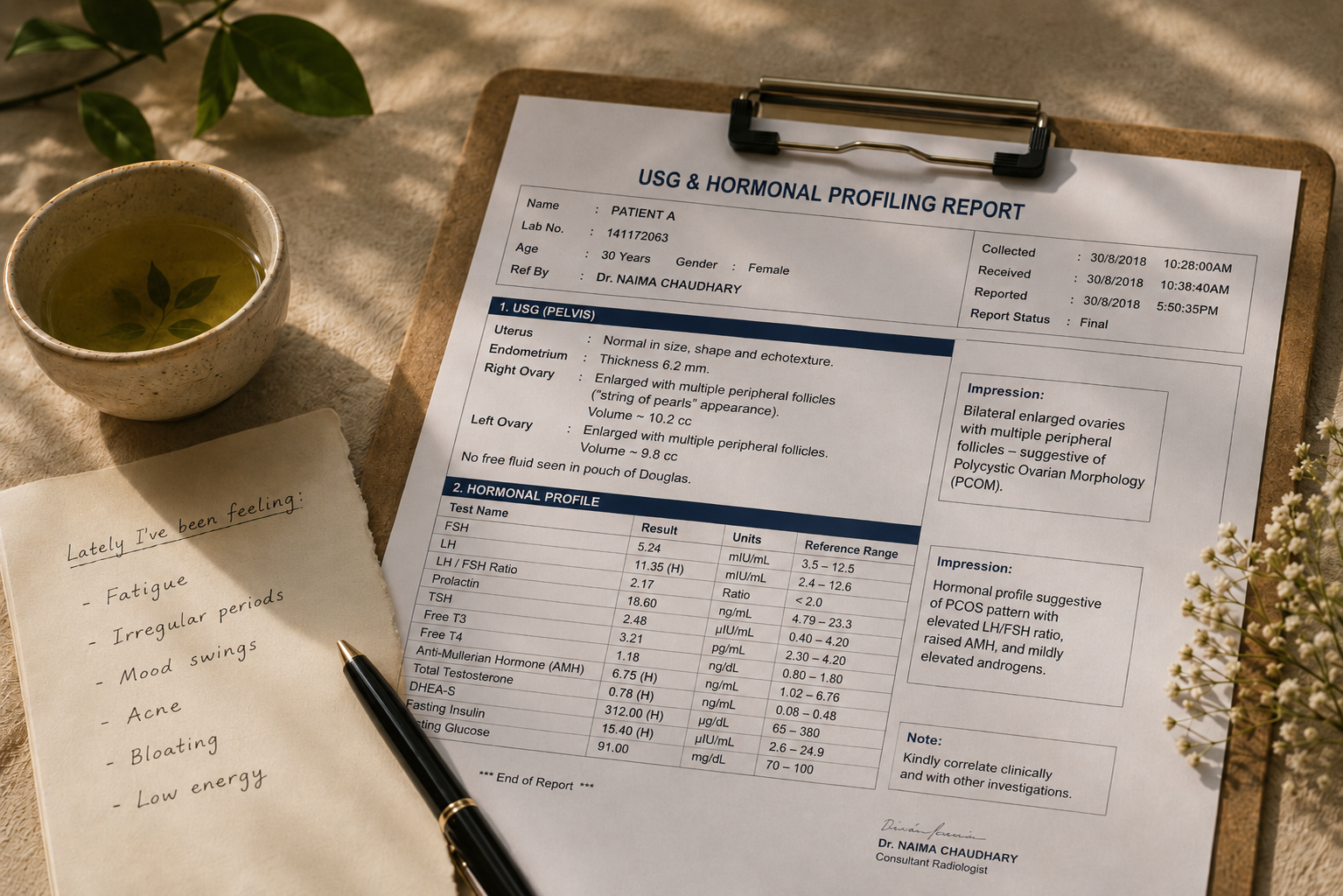
Why blood tests come back "normal" while you feel terrible, and the six stages of imbalance Ayurveda sees long before anything shows up in a lab.
Most women with hormonal symptoms have heard the sentence at least once. Your reports look fine.
The strange part isn't that it gets said. It is how often it is both technically correct and entirely beside the point. Blood panels are excellent at catching diseases that have already arrived. They are not designed to catch the years of drift that come first. And most women dealing with hormonal symptoms are living inside exactly those years.
This isn't a flaw in modern medicine. It is a design choice. Lab tests evolved to identify clinical disease so it could be treated. They were never built to capture the slow accumulation of imbalance over a decade.
But that decade is where most women spend their time, and it has its own pharmacology, its own diagnostics, its own logic. Ayurveda has been working on this layer for a very long time and it is precisely where shatavari juice benefits become most relevant.
What a lab test can and cannot see
The woman whose cycle quietly shifted from 28 to 35 days over two years or randomly started skipping a month or notices worse PMS symptoms or starts getting frequent allergies . Who feels heavier without having gained weight. Whose skin has dulled. Who sleeps but never feels rested. Who craves sugar in the afternoons in a way she didn't at 22. Her bloodwork will usually come back within normal range. She does not have a diagnosis. She also does not feel well. Both things are true.
The recommendation she gets at this stage is usually advice she has heard before. Eat better, sleep more, manage stress. The advice is correct, but it is unstructured, and most women have heard it so many times it has lost meaning. What is missing is a framework that takes the in-between seriously enough to actually intervene in it.
A hormone panel measures where the imbalance ended up. Not how it got there.
The six stages Ayurveda recognises
Ayurveda divides any disease into six progressive stages, a sequence called Kriya Kala. The first two are the ones blood tests can't see. They are also the ones where intervention works best.
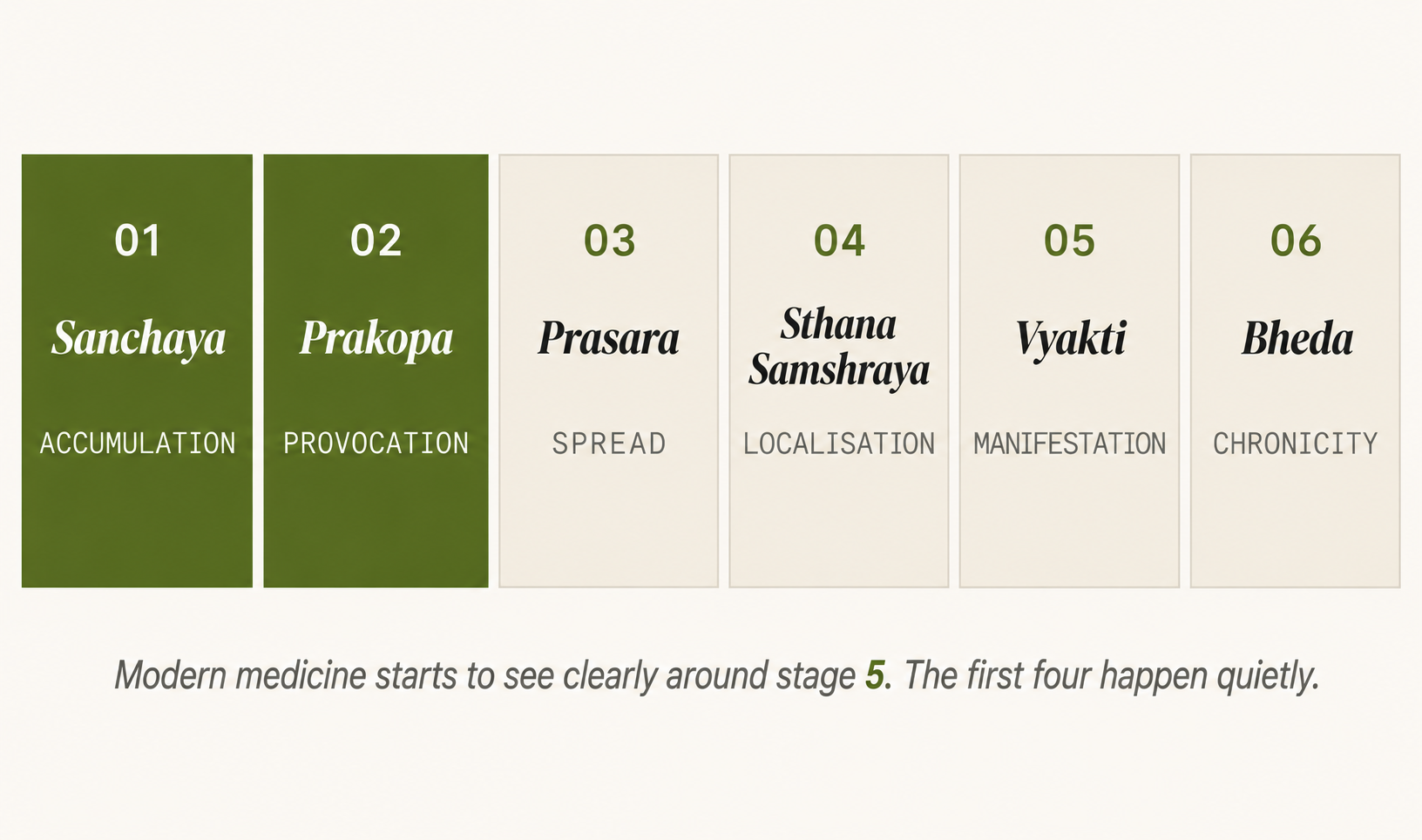
Sanchaya is an accumulation. The quiet build-up. A slight heaviness after meals. A reluctance to get out of bed that you blame on the weather. Skin that has lost some glow. Cycles a day or two off. Nothing a test would flag.
Prakopa is provocation. Heaviness becomes bloating. Tiredness becomes recognisable fatigue. Cycle drift becomes a pattern. Skin starts breaking out in specific spots. This is usually when women first start googling. And still, on paper, nothing is wrong. Kapiva ‘s shatavari juice benefits people going through these early, pre-diagnostic stages.
By the time something shows up on a blood test, the imbalance has already moved through four stages. That is why your symptoms feel real and your reports feel wrong. They are. They are looking at the same thing at different resolutions.
How the imbalance actually moves
Here is where Ayurveda's model gets interesting. It doesn't just say "things go wrong." It has a specific picture of how a single upstream problem cascades into the body's seven tissue layers. The classical name is Kedari Kulya Nyaya, the field-and-channel theory. Once you see it, hormonal symptoms stop looking random.
Ayurveda imagines the body's tissue layers as seven irrigated fields. Water from one source, your digestion, flows through channels and nourishes each field in turn. If the source is impure or a channel blocks, every field downstream gets less. The reproductive field, Artava, sits last in line.
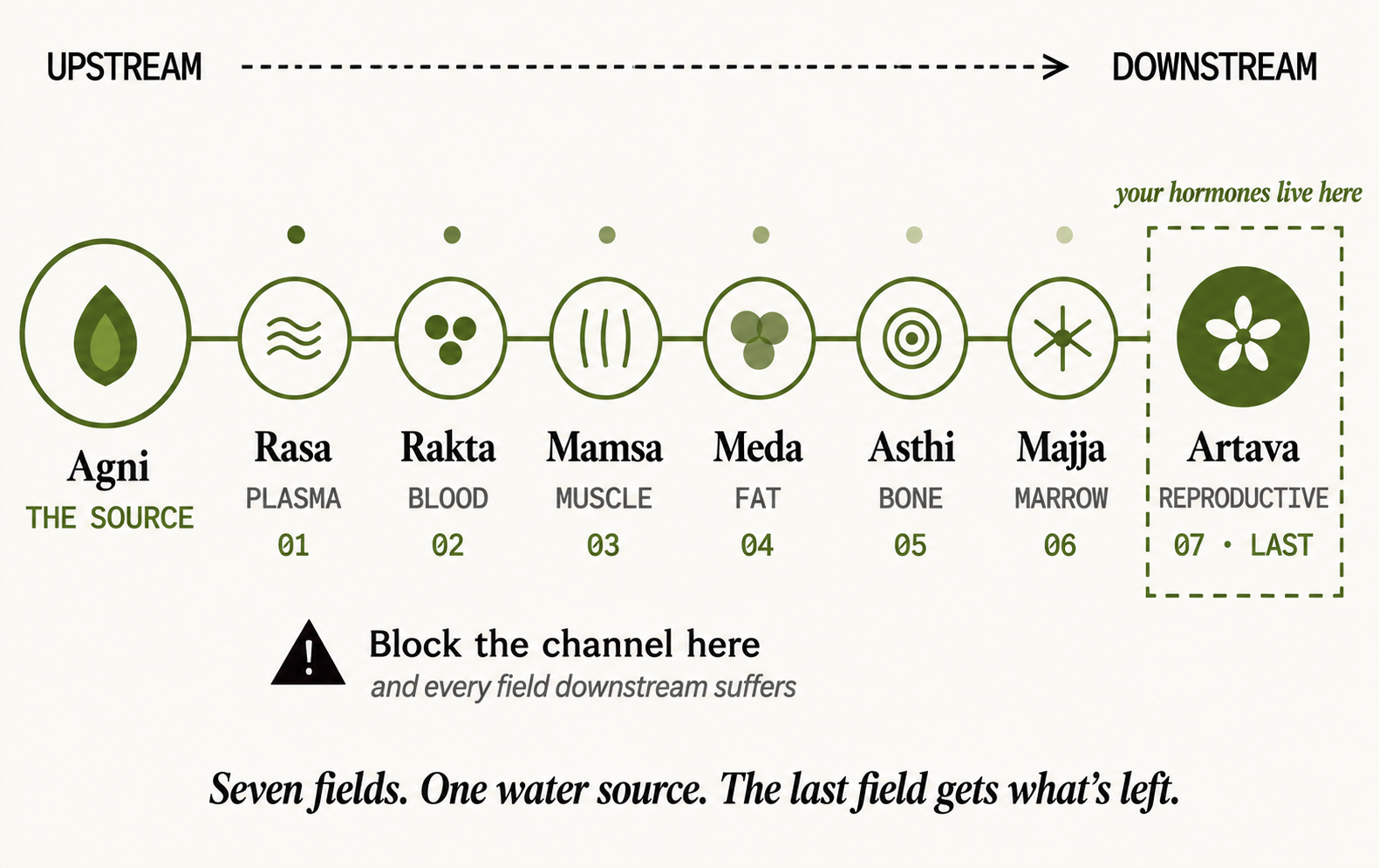
This is why women with PMOS rarely have only menstrual symptoms. They also have skin issues, hair fall, fatigue, weight that won't budge, sleep disruption, anxiety. Same cascade. Different fields. A test that looks only at reproductive hormones is reading the last field while ignoring the six upstream of it. A multi-herb shatavari juice is formulated with this sequence in mind, nourishing the upstream tissue layers that feed into the reproductive system.
This is also why Ayurvedic treatment for hormonal symptoms almost never starts with the hormone. It starts with digestion. Then metabolism. Then the relevant tissue. Then, finally, the reproductive layer. The order isn't arbitrary. It mirrors the order in which the imbalance arrived.
The shatavari juice benefits follow this same layered logic, supporting digestion and metabolism first so the herbs reach the reproductive layer in the right order.
So what do you do?
If your reports are clean and your body isn't, you start with the things a lab can't measure. How is your digestion? Is your sleep restorative or fragmented? Does your energy hold through the day or crash in the afternoon? How has your cycle shifted in the last year, even slightly? These are real data points. They just don't show up on a panel.
The catch is reading them properly. Most of us don't have a working vocabulary for our own digestion, let alone the patterns it is part of. Knowing which questions to ask, in what order, and what the answers actually mean is a skill that takes years to develop. It is exactly what an Ayurvedic consultation does for you. Not a second opinion on your bloodwork. And while you build that vocabulary, a well-formulated shatavari juice offers daily, multi-layered support for the systems that sit upstream of your hormones.
REFERENCES Ashtanga Hridaya, Sutrasthana, on Kriya Kala (six stages of disease progression), Kedari Kulya Nyaya (field-and-channel theory), and Roga-Rogi Pariksha (patient examination).
Author
Dr Anushri Shah
BAMS I- 111177-A
Experience: 5 years general physician