
The four herbs in every wellness aisle.
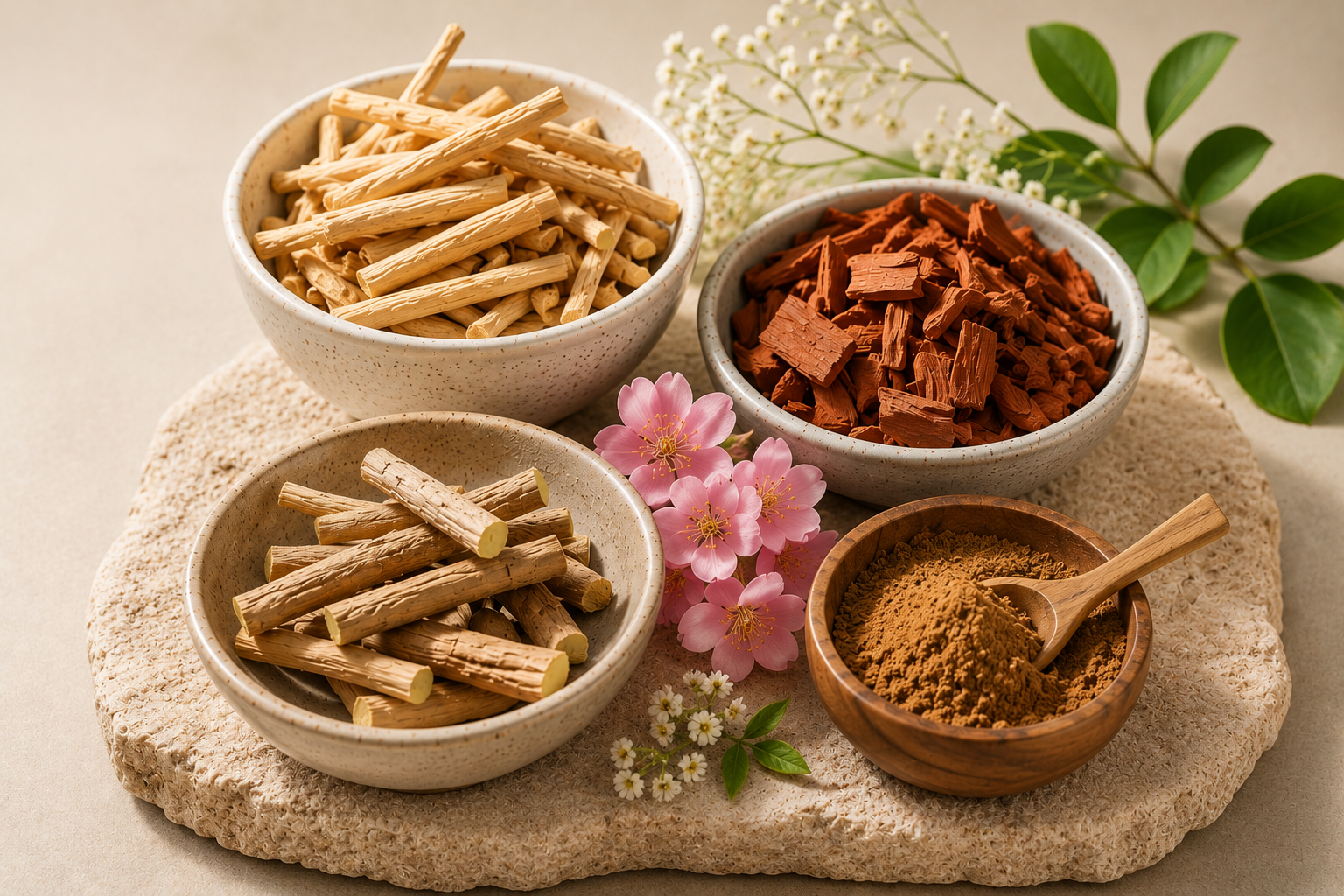
Shatavari, Ashoka, Lodhra, Mulethi. They show up in almost every women's product on the shelf. Here's what each one actually does, and why they work better together.
If you've walked into a wellness store in the last year, you've seen these four names. They're in capsules, juices, teas, powders. The labels say things like "hormonal balance" and "feminine vitality." Most women buy one, take it for two weeks, feel nothing dramatic, and stop.
That's not the herbs' fault. The problem is that each of these four does something specific, for a specific kind of woman. Used right, they have been working for centuries. Used randomly, they don't really do much.
Here is the short version of each.
Shatavari, the nourisher
Shatavari is the herb everyone starts with, and for good reason. It is not pushing your body to do anything new. It is restoring what has worn down. Think of it as the herb for the woman who is tired, depleted, recovering from a hard cycle, or running on stress.
Modern research backs this up. It contains compounds called shatavarins that affect oestrogen receptors and the stress response. It is also one of the few herbs with consistent evidence for supporting milk supply in breastfeeding mothers. Many of the shatavari juice benefits that women report trace back to these specific compounds.
Best for: Fatigue, scanty or painful cycles, dryness, postpartum recovery, and the kind of hormonal slump that follows years of stress.
Ashoka, the regulator
If Shatavari is for depletion, Ashoka is for excess. It is the herb classical Ayurveda turned to for heavy bleeding, painful periods, and cycles that have gone irregular in the direction of "too much." Clots, cramps, flooding.
It acts directly on the uterus. Small clinical trials have shown its benefit in heavy menstrual bleeding and period pain. A 2023 case study even documented a PMOS patient's cycle normalising in 30 days on a protocol that included Ashokarishta, the classical fermented preparation.
Best for: Heavy or clotted bleeding, painful periods, short and intense cycles.
In the classical pharmacopoeia, these herbs almost never appear alone. The proportions were arrived at over centuries because, on their own, each herb does one thing well and a few things badly.
Lodhra, the quiet specialist
You have probably not heard of Lodhra. That is a shame, because it is one of the most specific herbs in the entire women's-health pharmacy. Classical texts use it for white discharge, abnormal bleeding, and what they called "lower pelvic heaviness."
The modern research is interesting here. Lodhra has been studied for its effects on FSH and LH, the two pituitary hormones at the centre of PMOS, and for reducing ovarian cyst formation. It is almost never used alone. It is usually paired with Ashoka for menstrual issues, or built into PMOS protocols.
Best for: PMOS, irregular discharge, uterine inflammation, hormonal symptoms with a "congested" quality.
Mulethi, the stress modulator
Mulethi is liquorice. It is one of the most used herbs in the world, and the one that needs the most caution.
For women, it does two things. It gently supports oestrogen activity, useful when levels are low. And it helps regulate cortisol, your stress hormone. That makes it relevant for the kind of hormonal mess that follows years of burnout.
But (and this matters) Mulethi can raise blood pressure and cause fluid retention if taken in high doses for long periods. It is not a daily tea you sip for months. Used correctly, for defined periods, it is genuinely powerful. Used casually, it can cause problems.
Best for: Stress-driven hormonal symptoms, post-pill recovery, low-oestrogen presentations, hormonal pigmentation.
Noni, the metabolic tonic
Noni sits slightly outside the classical Ayurvedic women’s-health canon. Traditionally used across Polynesian and South Asian medicine for fatigue, inflammation, and recovery, it has recently become interesting in PMOS research. Unlike Ashoka or Lodhra, it is not acting directly on the uterus. The focus instead is on insulin resistance, oxidative stress, and chronic inflammation — the deeper metabolic terrain many PMOS patients are dealing with underneath the cycle irregularity.
Best for: Metabolic PMOS, inflammatory weight gain, fatigue, and the “burnt out” hormonal picture where stress and metabolism begin affecting the cycle together.
Why a formulation beats a single herb
Here is the bit single-ingredient marketing tends to leave out. Across every classical preparation for women's health, the herbs above appear in combination, never alone. Ashokarishta, Pushyanuga Churna, Lodhrasava, Shatavari Ghrita. The proportions in these formulations were arrived at over centuries because, on their own, each herb does one thing well and a few things badly. Together, in the right ratios, they balance each other out.
A woman dealing with PMOS, for example, rarely has just one problem. She has depletion from years of stress (a Shatavari problem), cycles that have gone irregular (an Ashoka problem), inflammation in the reproductive layer (a Lodhra problem), and a cortisol pattern that won't settle (a Mulethi problem). Asking any one herb to address all of this is asking too much.
Kapiva's Shatavari Balance Juice is built on this principle. Shatavari forms the base. Around it sit a small group of supporting herbs drawn from the same classical pharmacopoeia, in proportions tested across centuries rather than guessed. What you are taking is not one herb doing one job. It is a small, balanced formulation doing several jobs at once.
That is the difference between a supplement habit and a tradition. A single-ingredient capsule asks one herb to do the work of five. A formulation distributes the work the way Ayurveda always has.It is a small, balanced formulation doing several jobs at once. That is where the real shatavari juice benefits come from.
That is the difference between a supplement habit and a tradition. A single-ingredient capsule asks one herb to do the work of five. A well-made shatavari juice distributes the work the way Ayurveda always has.
REFERENCES Ashtanga Hridaya and Bhavaprakasha Nighantu. Modern pharmacology research on Asparagus racemosus, Saraca asoca, Symplocos racemosa, and Glycyrrhiza glabra. JAIMS 2023 case study on Ayurvedic PMOS management.
Author
Dr Anushri Shah
BAMS I- 111177- A
Experience: 5 years general physician