
Before what you eat, how you eat
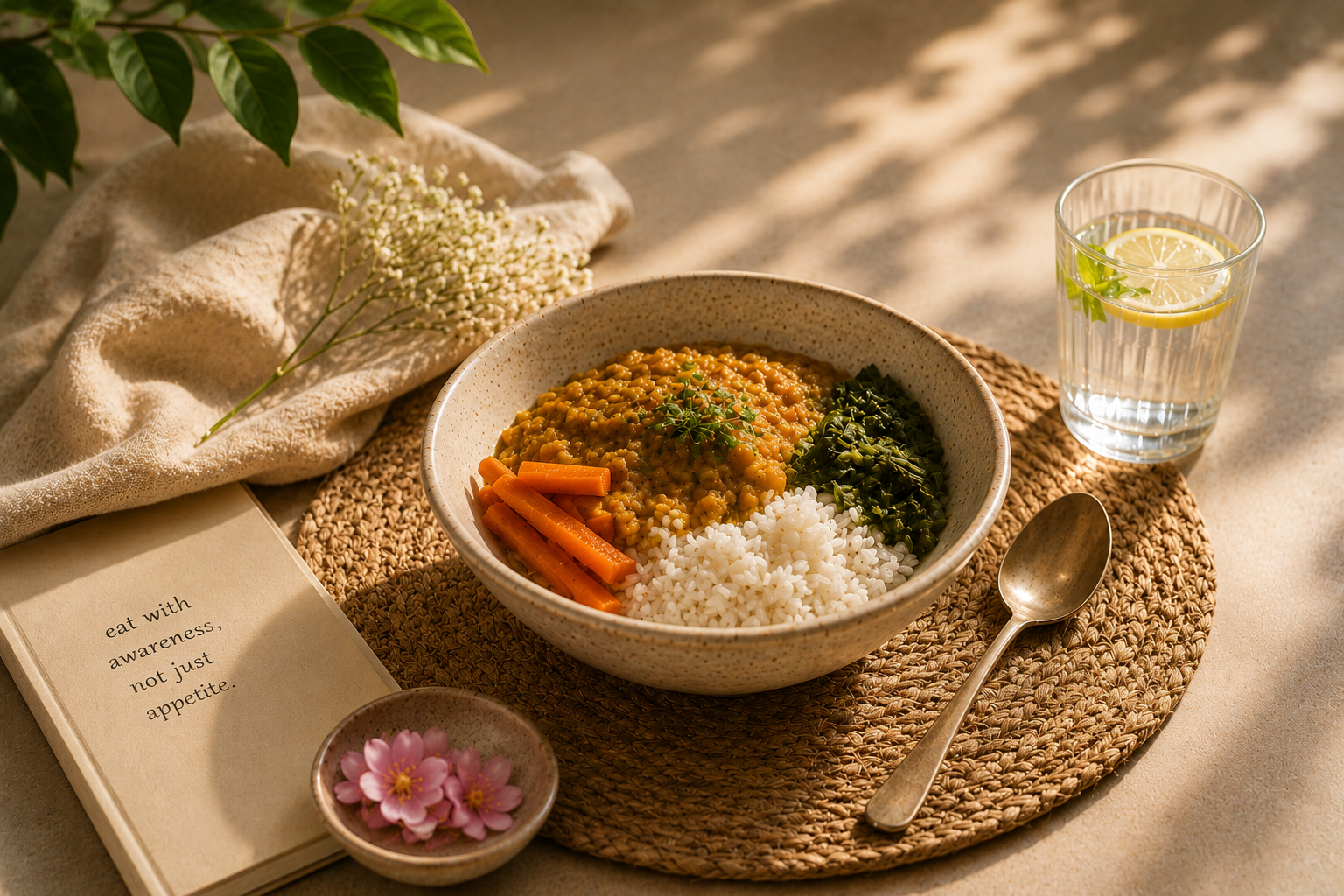
Most diet advice is about what goes on the plate. Ayurveda has been talking, for centuries, about everything that surrounds it.
You've heard the rules. Eat when you're hungry. Stop when you're full. Don't label food as good or bad. Your body knows.
Mostly, this is good advice. It rescued a generation from calorie-counting. But there is a layer underneath it that most modern diet writing skips entirely. Not what you eat, but how. The conditions around the meal, not just the contents of it.
This is the part Ayurveda has been writing about for fifteen hundred years.
The part nobody talks about
The physician Vagbhata wrote an entire framework about how to eat. He listed eight conditions that decide whether a meal actually nourishes you or quietly disturbs your system. Things like temperature, posture, attention, timing, and season.
Most modern diet advice covers maybe two of these. The other six it just assumes away. But you cannot assume them. A perfectly balanced plate eaten standing up, in a rush, while answering emails, with ice water, in the wrong season, is not the same meal as the same plate eaten warm, sitting down, with attention.
And this isn't mysticism. Modern research now confirms the pieces. Eating while stressed reduces nutrient absorption. Cold drinks slow gastric emptying. Distracted eating dulls satiety signals and predicts you'll overeat at the next meal. Vagbhata just observed the outcomes first.
Hunger is feedback. Whether you can trust it depends on the conditions in which your body learned to send it.
Why this matters for hormonal symptoms
Here is the part specific to women dealing with PMOS, irregular cycles, or the kind of diffuse hormonal symptoms that have become extremely common. Ayurveda holds that hormonal trouble starts in the digestive layer long before it shows up in the reproductive one. Weak digestion leads to metabolic disruption, which leads to hormonal symptoms.
Modern medicine, somewhat reluctantly, agrees. The gut-hormone axis is now established in science. Insulin resistance and gut inflammation are recognised as central drivers of PMOS. The chain Ayurveda described is the same chain endocrinologists trace today, just with different vocabulary.
So if your signals have been off for years, the answer isn't to obey every craving. It is to repair the conditions that produce honest signals in the first place.
What to actually do
The interesting part: most of this is free.
Eat warm. Cold food strains digestion.
Sit down. Standing changes the body's response.
No phone. Distraction dulls fullness signals.
Wait between meals. Let the last one finish.
Room-temp water. Cold water slows everything.
Stop before full. Leave room for digestion.
Don't eat when agitated. Stress shuts digestion down.
Eat by season. January and July are different.
There is a second layer about preparation. The same ingredient changes properties depending on what you do to it. Raw milk and cooked milk behave differently in the body. A steamed vegetable is not the same food as the same vegetable fried. Adding ghee, turmeric, and black pepper isn't seasoning. It is a bioavailability strategy. Curcumin absorption rises by roughly 2,000% with piperine and fat, a fact modern pharmacology confirmed in the 1990s and Vagbhata recommended in the 6th century.
The same logic applies to herbs like Shatavari. A well-formulated shatavari juice pairs the herb with complementary ingredients that support absorption. The shatavari juice benefits depend on this kind of thoughtful preparation.
And a third layer about seasons. Your digestive capacity isn't constant across the year. It is strongest in winter, weakest in summer, and monsoon. Your body in January is a measurably different metabolic organism than your body in July. Eating identically across all twelve months is, biologically speaking, a fairly recent and, dare I say a capitalist and industrial habit.
None of this is a diet. It is a set of conditions. And women who try it tend to report the same thing after a few weeks: not that they have learned to control their cravings, but that the cravings have grown quieter. The signals start telling the truth again.
None of this is a diet. It is a set of conditions. And women who try it tend to report the same thing after a few weeks: not that they have learned to control their cravings, but that the cravings have grown quieter. The signals start telling the truth again. At that point, intuitive eating actually works. Add shatavari juice to that foundation, and see the shatavari juice benefits, because your digestion is finally delivering the herbs where they are needed.
REFERENCES Ashtanga Hridaya, on Ahar Vidhi Vishesh Ayatana and Rutucharya. Modern research on the gut-hormone axis, postprandial physiology, and curcumin bioavailability.
Author
Dr Anushri Shah
BAMS I- 111177- A
Experience: 5 years general physician